Social platforms like TikTok, Instagram, and YouTube now collectively drive over 60% of product discovery, more than Google’s 34.5% share of total search. People are increasingly searching on these apps the same way they’d search Google, typing full questions into the search bar instead of just scrolling for entertainment. So, are hashtags still relevant in a world where social platforms have become search engines?

Short answer? Not really. The algorithms behind Instagram, TikTok, Facebook, and LinkedIn now take your captions, on-screen text, spoken audio, and alt text into consideration to decide who sees your content, and hashtags are just one weak signal among many. Not to be dramatic, but this is the death of the hashtag. Here’s how your business can pivot accordingly, and where a digital marketing agency can help.

Are Hashtags Still Relevant?

Somewhat, but probably not the way you’re using them, and the answer varies by platform. Adam Mosseri, Instagram’s CEO, has repeatedly said hashtags don’t meaningfully help with distribution. As he put it, “I wouldn’t try to think of hashtags as a way to get more distribution.” They still help Instagram understand what a post is about, but that’s context, not reach.

TikTok’s algorithm tells a similar story: it leans on video content and audio, not hashtags, to match posts to viewers. LinkedIn and Facebook follow the same general pattern, though, as we’ll get into below, LinkedIn hashtags still carry a bit more weight than the others.

Put simply, a hashtag won’t hurt your post, but it no longer does the job it used to. If you’re still stacking 15 to 30 tags under every caption in an effort to grow your social media accounts, that’s wasted effort. Use two or three specific, relevant hashtags as a light categorization tool, and put your real effort into making sure the right keywords appear in your caption and video content.

Social Media SEO is the Real Strategy now

Social media Search Engine Optimization (SEO) means writing your captions, video scripts, and profile copy the way people actually search: full phrases, questions, specific product names, and specific locations. If your customer were to type “best coffee shop downtown Seattle” into TikTok’s search bar, that phrase needs to show up somewhere in your caption or spoken in your video, not buried in a hashtag.

This shift rewards the same discipline as traditional SEO: know the phrases your audience searches, and use them naturally in your content.

Instagram SEO

Instagram indexes captions, alt text, and even audio transcriptions to surface content in its search results. Your profile name and bio matter too, if they include searchable keywords. A local business account with “Seattle’s neighborhood coffee shop” in its bio will show up in more searches than one that just says “Susan’s Snazzy Sips”.

Instagram SEO tips:

  • Write your captions as if you’re answering a search question, not just describing the photo.
  • Add alt text with real descriptive keywords — tools like Later or Sprout Social make this easy to do while scheduling.
  • Search Instagram for keywords in your industry to see how competitors are already using them.

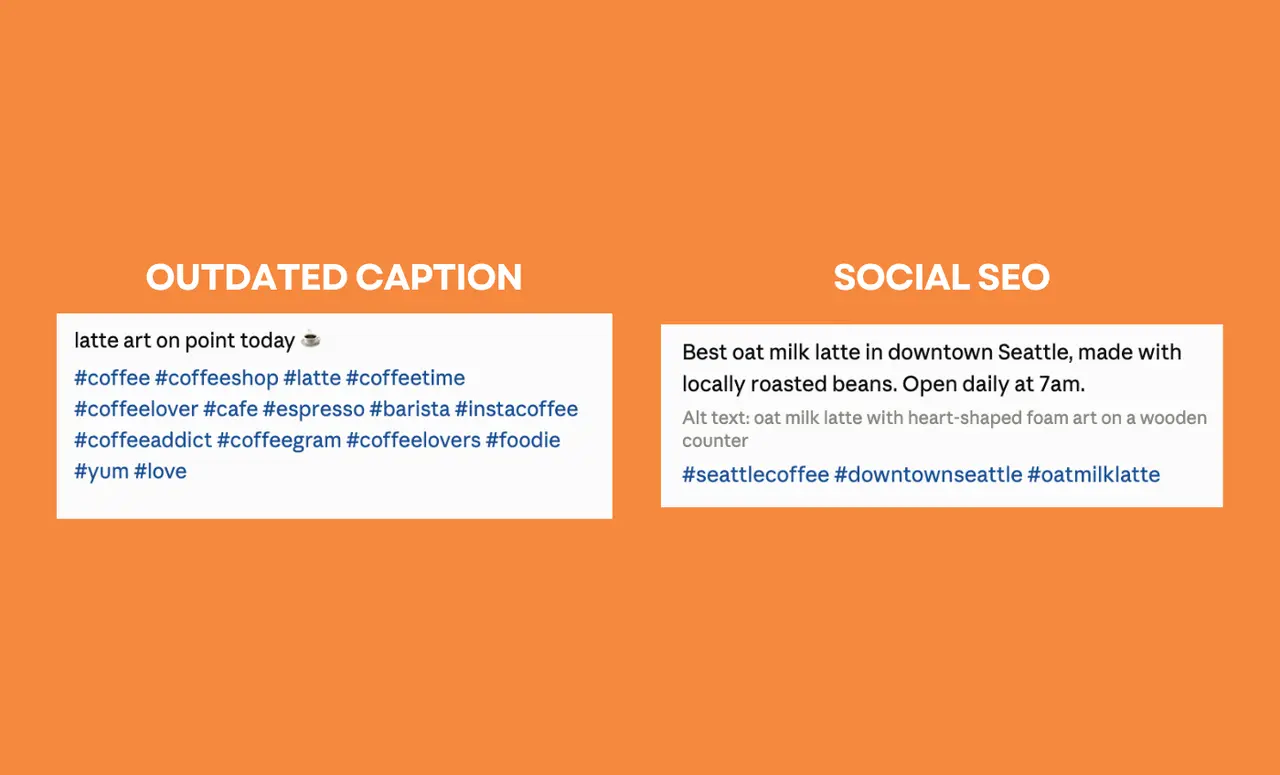
Side-by-side cards show outdated and improved Instagram captions for a latte photo. The left uses only hashtags, while the right is a detailed description with targeted hashtags. Orange background.

TikTok SEO

TikTok has openly positioned itself as a search engine, particularly for younger users who increasingly start product research there instead of Google. The platform reads spoken audio, on-screen text, and captions to determine what a video is about and match it to search queries. Give TikTok SEO the same attention you already give your website’s SEO.

TikTok SEO tips:

  • Say your target keyword out loud in the video. TikTok’s speech-to-text indexing picks it up.
  • Put the keyword in your on-screen text and your caption too, not just one or the other.
  • Match your video titles to real questions people type into TikTok search, the same way you’d research a blog topic.
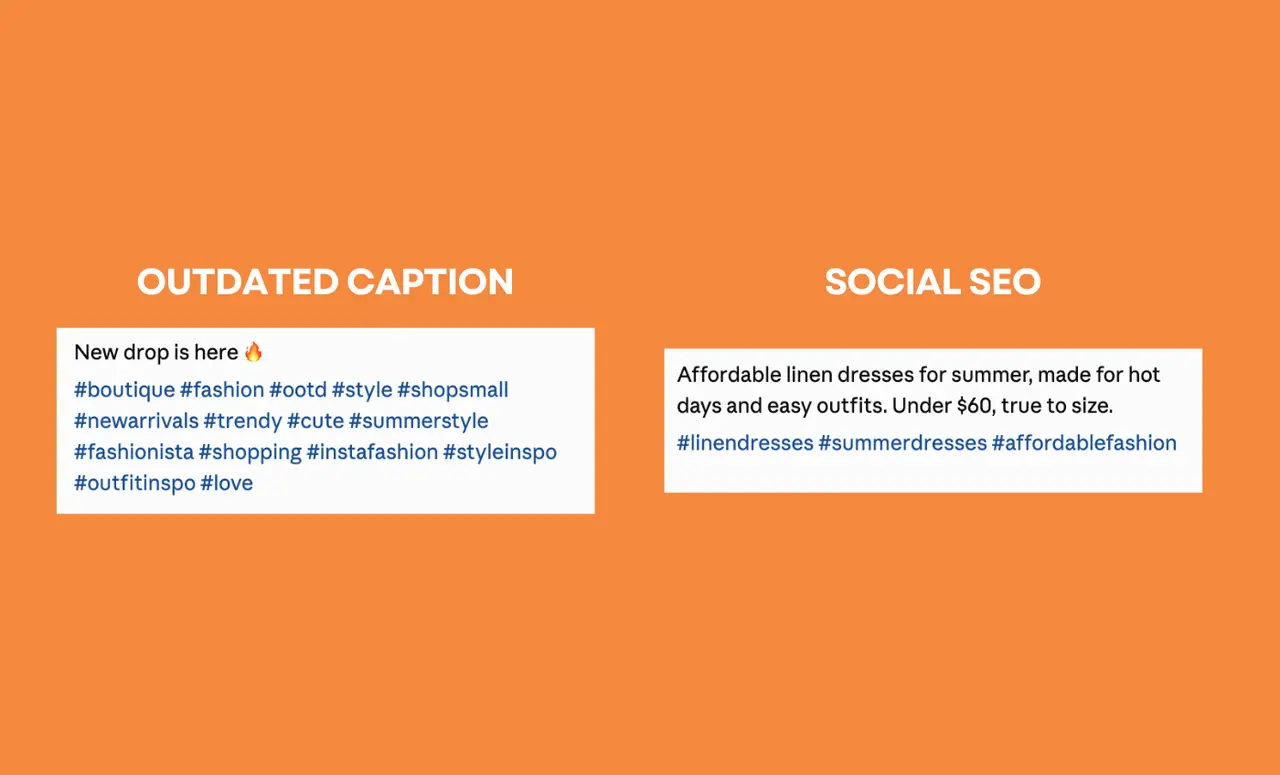
Two white text boxes on an orange background compare an Outdated Caption full of hashtags with a Social SEO example featuring descriptive keywords for linen summer dresses and relevant, minimal hashtags.

Facebook and LinkedIn: Different Platforms, Different Rules

Hashtags don’t behave the same way on every platform, and Facebook and LinkedIn are proof of that.

Facebook

On Facebook, hashtags mostly work as a search and categorization tool, not a reach booster. The best hashtag strategy is just one to two relevant hashtags per post. The bigger opportunity on Facebook right now is product discovery: Sprout Social’s 2026 Social Media Content Strategy Report found Facebook is the top platform users turn to for finding new products, with nearly 40% of social users searching there. Your captions and product descriptions carry more weight than any hashtag you add.

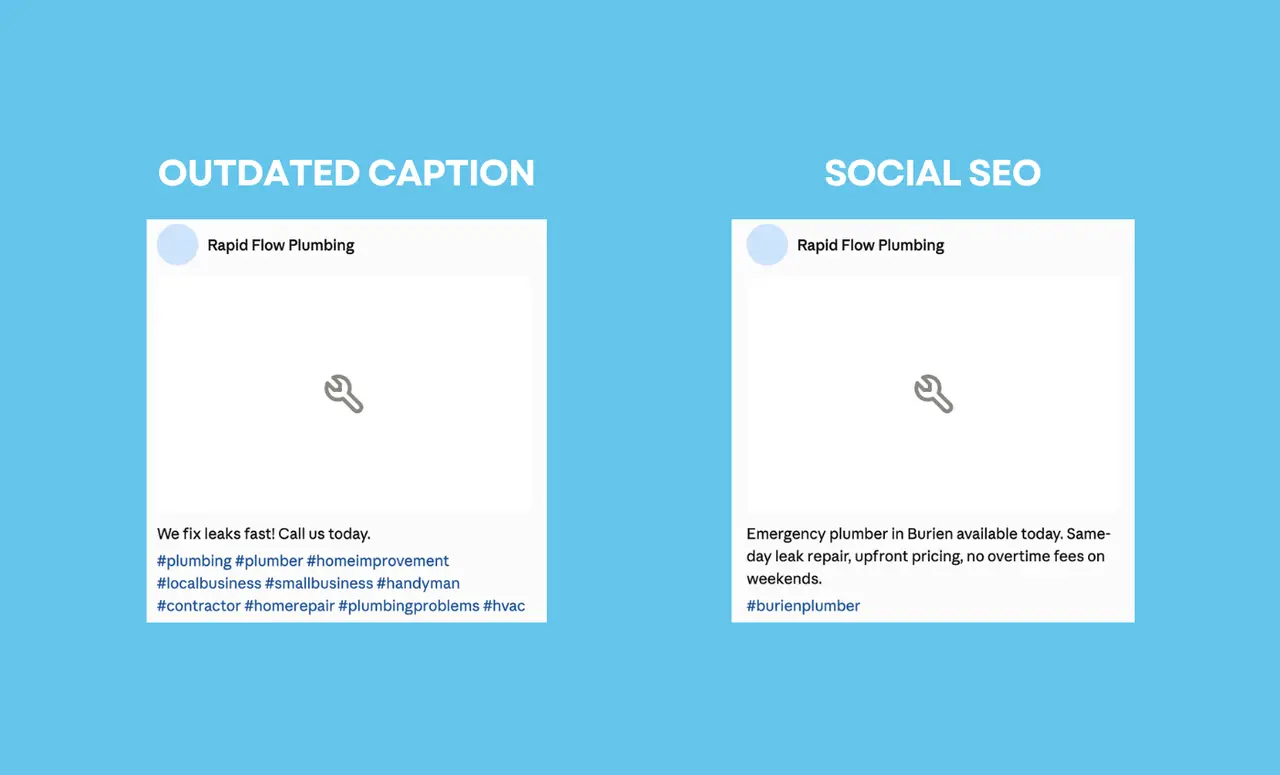
Two social media posts for Rapid Flow Plumbing are shown side by side. The left post lists hashtags, while the right post includes a detailed service description and location-specific hashtag. Both are set against a light blue background.

LinkedIn

LinkedIn is the platform where hashtags have held onto more relevance, but the strategy looks different than it did a few years ago. LinkedIn removed hashtag following in 2024, so hashtags no longer create a subscribable feed the way they once did. However, hashtags still help LinkedIn’s algorithm match your post to the right audience and signal your topic for search, even though they no longer drive reach on their own. 

The key difference: a hashtag amplifies good copy, but it doesn’t rescue weak copy. Use 3 to 5 specific, relevant hashtags, and pick a mix of one broader industry tag and a couple of niche ones your target audience actually interacts with. 

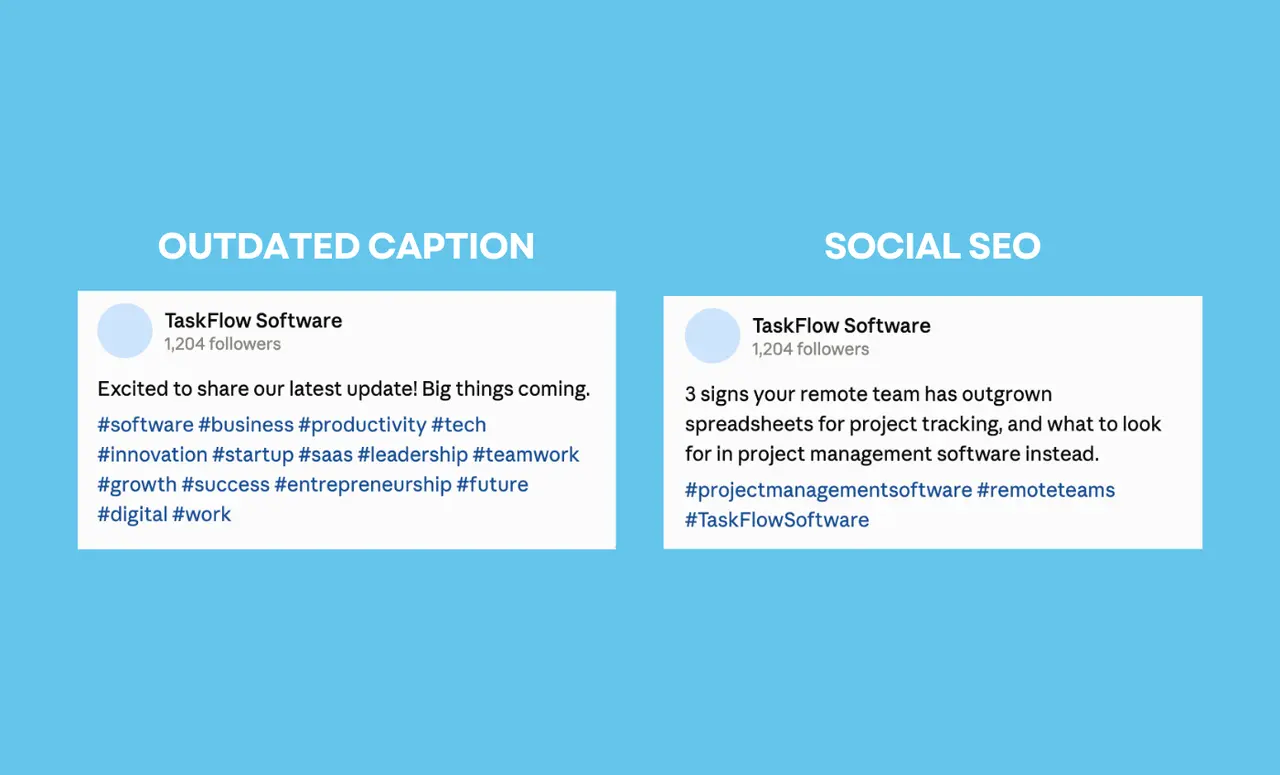
A comparison of two social media post captions for TaskFlow Software: on the left, an outdated caption with many hashtags; on the right, a social SEO caption focused on remote teams and project management.

How to Measure Social Media Profile Success 

Once you stop chasing hashtag reach, you need a new way to know what’s working. Here are a few metrics worth tracking instead:

  • Views/Impressions. The total number of times your post was displayed, including repeat views from the same person. A rising number here means your keyword strategy is working.
  • Reach. The number of unique accounts that saw your post, as opposed to total views. If views or impressions are climbing but reach isn’t, your content is being shown to the same people repeatedly rather than finding new search-driven traffic, which is the real goal here.
  • Saves and shares. These signal to every major platform that your content is worth showing to more people.
  • Keyword-ranked views (TikTok). TikTok’s analytics can show which search terms are driving traffic to specific videos. If a video is ranking for a keyword you didn’t target, that’s a signal to double down on that topic.
  • Engagement rate. Comments, shares, and saves are the strongest signal on Facebook and LinkedIn specifically. If engagement is flat despite consistent keyword use, the caption or the content itself needs work, not the keywords.

What This Means for Your Business

If your current process is still built around hashtag banks and “trending tags” lists, it’s time to refresh your strategy. The caption that wins now isn’t a well-crafted turn of phrase draped in hashtags; it’s the one that answers the question your customer is already typing into that platform’s search bar.

There has been a real shift in what “good social content” looks like, and it takes more than swapping a few hashtags for keywords. It means rethinking your captions, your bio, your video scripts, and your whole content calendar around what your audience is actually searching for.

Building an Expert Strategy

This brings us to the real question: how do you actually build a strategy like this? Long gone are the days of “post and go.” A solid social media strategy involves a lot more than thinking up clever captions and hashtag stuffing, though we’ll admit that was a fun era.

If you don’t have the bandwidth to rebuild that strategy on your own, that’s exactly what our Social Media Blueprint is built for: a full strategy document covering audience research, platform recommendations, content pillars, posting cadence, and brand voice guidelines, built around how your customers actually search each platform. We handle the strategy, you handle execution. 

If you’d rather hand off execution entirely, our Organic Social Media Management service takes it from strategy through monthly content calendars, captions, and reporting, so your team isn’t stuck relearning how each platform works with every algorithm update.

Ready to see what a search-first social strategy looks like for your brand? Get in touch, and let’s talk about where to start.